
Living in Your Home During a Whole-Home Renovation in Northern Virginia
By Dzala General Contractor
Published: November 17, 2026 · Last updated: November 17, 2026
Often yes, if the work is phased so that a bathroom, a place to sleep and a way to prepare food stay usable, dust is sealed inside the work zone, and every utility shutoff is planned in advance. Moving out for a phase is often easier when every bathroom or the only kitchen is out at once, when heating or electrical service is replaced in winter, or when paint in a pre-1978 home is disturbed in rooms you use.
Key takeaways
- Decide what must stay usable every day: at least one bathroom, sleeping space, a food station and a safe path through the house.
- Phase the house into a live zone and a work zone, and move the boundary on a written schedule.
- In Fairfax County, construction is generally allowed 7 a.m. to 9 p.m. on weekdays and 9 a.m. to 9 p.m. on weekends and holidays; your HOA may set its own rules.
- About three quarters of U.S. homes built before 1978 still contain some lead-based paint, according to the EPA, so testing and lead-safe work practices come first in older homes.
- Winter projects need a plan for heat, water and power shutoffs, and someone has to give inspectors access during the county's two hour arrival window.
A whole-home renovation changes every room, but it does not always mean leaving. Many Northern Virginia households stay for some or all of the project, especially when the work can move through the house in stages. Whether that works for your family depends on the scope, the age of the house, the season, and how much disruption you can live with.
This guide covers the decisions that make staying workable: phasing, dust and noise, older-home hazards, inspections, winter utilities and HOA rules. For what a whole-home project includes, see the whole-home remodeling service page. For budget planning, see the whole-home remodel cost guide.
Can you live at home during a whole-home renovation?
You can if the house still meets your basic daily needs while work is underway. The table below compares situations where staying tends to work with situations where moving out, even briefly, may be easier.
Table 1. Staying versus moving out, by situation
| Situation | Staying usually works when | Moving out may be easier when |
|---|---|---|
| Bathrooms | At least one bathroom stays usable in every phase | Every bathroom is under construction at the same time |
| Kitchen | A temporary food station with a sink nearby is possible | There is no water source near a temporary food station |
| Heating and cooling | The system stays running, or is down only on mild days | The system or ductwork is replaced during cold weather |
| Electrical | Circuits are switched over room by room | The main service is replaced and power is off for a longer period |
| Older paint | Testing shows no lead-based paint in work areas, or work areas can be sealed off from living space | Paint will be disturbed in rooms you use daily |
| Household needs | Adults who can tolerate noise and changing routines | Infants, people with respiratory conditions, or someone recovering from surgery |
| Layout | Work can move floor by floor or wing by wing | The house is opened up all at once, including stairs or exterior walls |
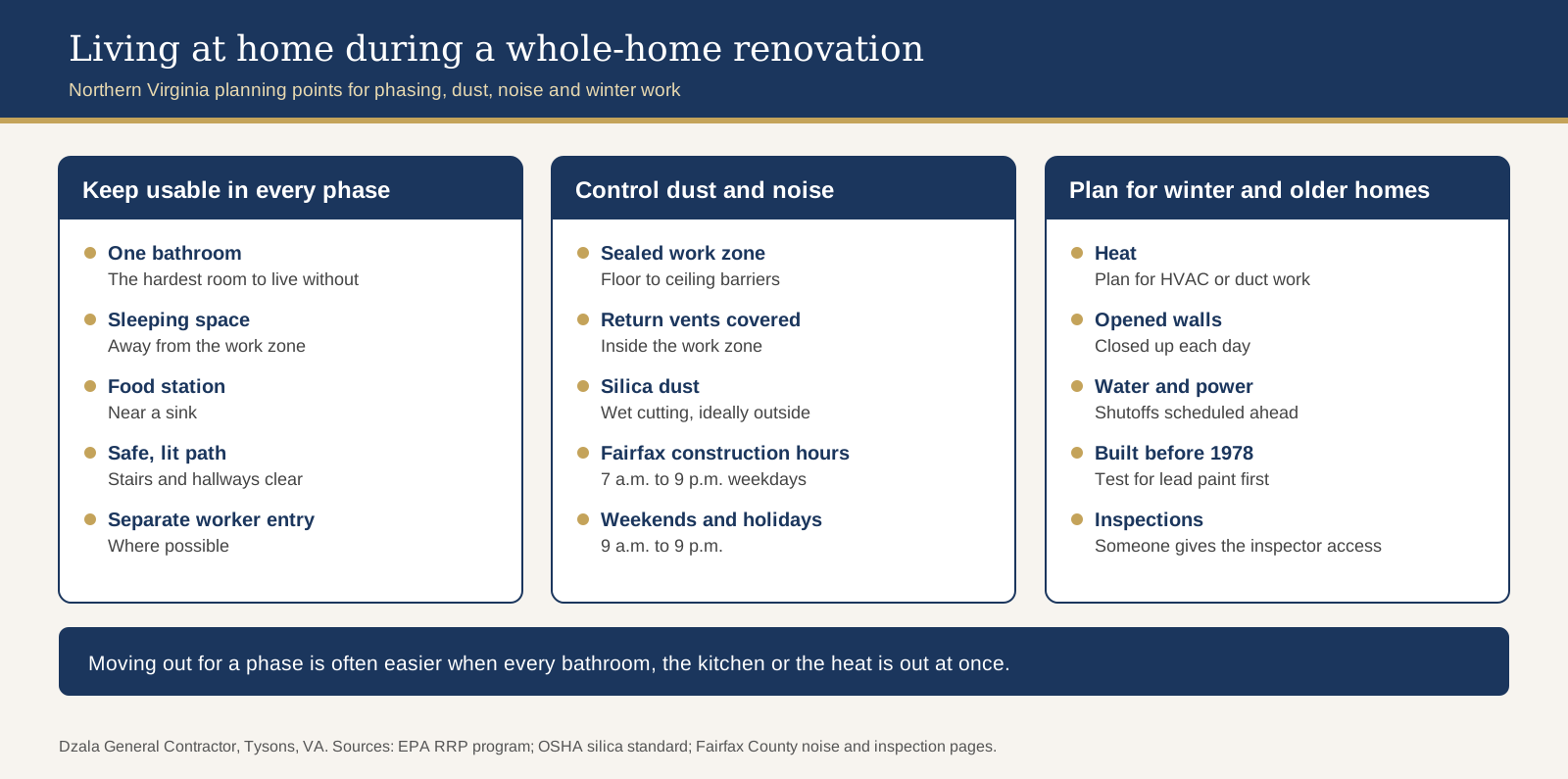
Many families split the difference. They stay during work on one floor, then leave for a week or two when the kitchen, the main bathroom or the heating system is out.
How should the work be phased so you can stay?
Phasing divides the house into a live zone, where the family stays, and a work zone, which is sealed off. The boundary moves as each phase finishes. A written phase plan should show which rooms are closed, which stay open, and what changes when the boundary moves.
Table 2. Questions to settle for each phase
| Phase question | Why it matters |
|---|---|
| Which bathroom stays usable? | Bathrooms are the hardest room to live without |
| Where is the temporary food station? | A microwave, a small refrigerator and access to a sink cover most meals |
| Which entrance do workers use? | A separate entry keeps traffic and dust out of the live zone |
| Which path stays clear for the family? | Stairs and hallways need to stay safe and lit |
| When are water, power or heat shut off? | Shutoffs should be scheduled and announced in advance |
| Where are materials stored? | Deliveries need a dry space that does not block exits |
A single dated schedule makes phasing work. Our article on home renovation project management explains why one person should own that schedule rather than each trade.
How do you keep dust and noise under control?
Dust. Seal the work zone with floor-to-ceiling barriers and a closable entry, cover return air vents inside the work zone, and protect floors along the path workers use. Keep doors to the live zone closed, and plan daily cleanup at the boundary.
Cutting concrete, stone, tile and similar materials creates silica dust. OSHA's construction standard for respirable crystalline silica requires employers to control that exposure, and it lists engineering controls such as wet cutting for many common tasks. Ask how cutting will be handled and where it will happen, ideally outside the house.
Noise. Fairfax County's noise ordinance page says construction activities are generally allowed from 7 a.m. to 9 p.m. Monday through Friday, and from 9 a.m. to 9 p.m. on weekends and holidays, with noise limited to 90 dB at property boundaries in residential areas. Those are legal limits, not a promise of quiet. If someone works from home, agree on the loudest tasks and their timing at the start.
What if your home was built before 1978?
Older homes add two hazards that should be tested before any demolition.
Lead-based paint. The EPA says about three quarters of U.S. homes built before 1978 still contain some lead-based paint, and that renovation in a pre-1978 home with lead-based paint can easily create dangerous lead dust. Under the EPA's Renovation, Repair and Painting (RRP) Rule, anyone paid to disturb painted surfaces in homes built before 1978 must hold EPA lead-safe certification, with workers trained in lead-safe work practices. If lead-based paint is present in rooms you use, staying elsewhere during that phase is worth considering.
Asbestos. Older insulation, flooring and other materials can contain asbestos. Fairfax County's permit-required list includes asbestos removal under miscellaneous work. Testing before demolition tells you whether that step belongs in the schedule.
How do inspections work while you live there?
Permitted work is inspected at set stages, and the inspector needs access to the work. In Fairfax County, the permit holder schedules inspections through the county's PLUS system, according to its building and trade inspections page. The county emails the applicant and the onsite contacts on the morning of the inspection with a two hour arrival window and the inspector's name and phone number, and approved plans need to be on site.
For a family living in the house, that means:
- Agree on who will be home, or who has access, during each arrival window.
- Keep pets secured on inspection days.
- Keep the path to the work zone clear.
- Expect walls to stay open until rough-in inspections pass.
Ask your contractor in writing who will schedule inspections and who will attend them.
What changes when you renovate in winter?
Winter is a common time to start, and it adds a utility plan to the schedule. Bring these questions to the planning meeting:
- Heat. If the furnace, heat pump or ductwork is being replaced, when will the system be off, and for how long? Is temporary heat part of the plan?
- Open exterior walls. If exterior walls, windows or the roof are opened, how will the house be closed up at the end of each day?
- Water. When will the water be shut off, and will any pipes run through cold or opened spaces?
- Power. If the electrical service is upgraded, when will the utility disconnect and reconnect power?
- Snow and access. Where will workers park, and who clears the path and driveway?
- Ventilation. How will fresh air reach the live zone while windows stay closed?
If the heating system or main electrical service will be down during cold weather, consider staying elsewhere for that phase.
Do HOA rules apply during a renovation?
Often yes. An HOA approval is separate from a county permit, and one does not replace the other. Exterior changes such as windows, siding or additions commonly need architectural review. Many associations also set rules for dumpsters, portable toilets, storage containers, parking and work hours, which can be stricter than the county's noise limits. Read your covenants and ask the association for its renovation rules before you sign a contract.
How should you set up daily life during the project?
- Pack and store items from every room in later phases, not just the first one.
- Set up the temporary food station before the kitchen closes.
- Move valuables, medications and important papers out of work zones.
- Plan for pets and children, including a quiet space away from the work.
- Agree on a regular update, such as a short weekly walkthrough.
- Keep a change log so every new decision has a written cost and schedule effect.
For how a project moves from consultation to completion, see the process page. For an example of a whole-home project in the area, see the Tysons whole-home renovation.
Frequently asked questions about living at home during a renovation
Can you live in your house during a whole-home renovation?
Often yes, if the work is phased so that a bathroom, sleeping space and a way to prepare food stay usable in every phase. Dust has to be sealed inside the work zone, and water, power and heat shutoffs need to be scheduled in advance. Many families stay for most of the project and move out briefly when the kitchen, the main bathroom or the heating system is out of service. The right answer depends on scope, season and household needs.
When should you move out during a renovation?
Consider moving out when every bathroom or the only kitchen is out at the same time, when the heating system or main electrical service is replaced in cold weather, or when lead-based paint will be disturbed in rooms you use. Households with infants, people with respiratory conditions, or someone recovering from surgery may also prefer to leave during demolition and the dustiest phases. A short stay elsewhere is often enough.
What hours can contractors work in Fairfax County?
Fairfax County's noise ordinance page says construction activities are generally allowed from 7 a.m. to 9 p.m. Monday through Friday and from 9 a.m. to 9 p.m. on weekends and holidays. Noise is limited to 90 dB at property boundaries in residential areas. Your HOA or condominium association may set stricter hours, and a household working from home can ask to schedule the loudest tasks at agreed times.
How do you protect your family from renovation dust?
Seal the work zone with floor-to-ceiling barriers and a closable entry, cover return air vents inside the work zone, and keep a separate entrance and path for workers where possible. Ask how cutting will be done, since OSHA's silica standard lists controls such as wet cutting for many tasks. In homes built before 1978, test for lead-based paint first, because the EPA warns that renovation can create dangerous lead dust.
Do I need to be home for county inspections?
Someone needs to give the inspector access. In Fairfax County, the permit holder schedules inspections, and the county emails the applicant and onsite contacts a two hour arrival window on the morning of the inspection. Approved plans need to be on site. Agree in advance on who will be home or who has access during each window, and keep pets secured and the work area clear.
Is it a good idea to renovate in winter?
It can be, with a utility plan. Winter work means planning for heat if the furnace, heat pump or ductwork is replaced, closing up any opened exterior walls each day, protecting water lines in cold spaces, and scheduling any power disconnect with the utility. Interior phases are less affected by weather than exterior ones. If heat or power will be off during cold weather, plan to stay elsewhere for that phase.
Ready to plan a whole-home renovation you can live through?
See the whole-home remodeling service page for what Dzala General Contractor offers. When you are ready, request a quote or call (703) 919-1645 with a floor plan or photos, the year your home was built, and the checklist above.
Dzala General Contractor
8609 Westwood Center Dr Ste 110, Unit 119, Tysons, VA 22182, United States
Phone (703) 919-1645
Hours, Eastern time: Monday to Saturday 8 a.m. to 7 p.m., Sunday closed (ET)
Email dzalausa@gmail.com
More from the journal
Let's get started.
Tell us about your property and what you would like to change. We will review the details and follow up within one business day to arrange your free in-home consultation and written quote.
No obligation and no sales pressure. Your information stays with us.