
Tysons Condo Kitchen or Bath Remodel: What to Check With Your Building First
By Dzala General Contractor
Published: November 17, 2026 · Last updated: November 17, 2026
Before you plan a condo kitchen or bathroom remodel in Tysons, get your association's renovation rules and read your condominium instruments. Most buildings want an approved alteration application, the contractor's certificate of insurance, booked service elevator time, and work kept within set hours before anyone starts. Virginia law lets unit owners alter their units unless the instruments limit it, and Fairfax County treats condos as commercial buildings for permits.
Key takeaways
- Under Va. Code § 55.1-1931, owners may alter their units unless the condominium instruments prohibit or limit it, as long as the work does not impair structural integrity or change the exterior appearance.
- Fairfax County says apartment buildings and condos are considered commercial under the building code, so condo remodels need commercial building permits rather than the residential path.
- Ask the building for its alteration application, insurance requirements, elevator and loading dock rules, work hours and water shutoff process before you finalize the design.
- Moving a kitchen or bathroom away from existing risers is often limited in high-rise buildings, so confirm the plumbing locations early.
- Fairfax County generally allows construction from 7 a.m. to 9 p.m. on weekdays and 9 a.m. to 9 p.m. on weekends and holidays, but many buildings set shorter hours.
Tysons has a growing number of high-rise and mid-rise condominiums, and their owners remodel kitchens and bathrooms for the same reasons homeowners do. The difference is that a condo remodel answers to two authorities: the county, which issues permits, and the association, which controls the building. Many delays come from the second one, because approvals, insurance documents and elevator bookings take time to arrange.
This guide lists what to check with your building before you commit to a design or a start date. For local context, see our Tysons service area page, which notes that condominium remodels need building management approvals and certificates of insurance in place before work starts, plus scheduled service elevator access.
What can a Virginia condo owner change inside a unit?
Virginia's Condominium Act sets the baseline. Under Va. Code § 55.1-1931, any unit owner may make improvements or alterations within the unit, except to the extent the condominium instruments prohibit, restrict or limit them. The work must not impair the structural integrity of any structure or lessen the support of any part of the condominium. The owner also may not change the exterior appearance of the unit or any other part of the condominium, except as the instruments allow.
In practice, the condominium instruments, the bylaws and the board's rules decide most of what you can do. They often define which pipes, walls and systems belong to the unit and which are common elements, and they may require board or management approval before work starts.
Table 1. Typical condo remodel items and who usually decides
| Remodel item | Usually decided by | What to check |
|---|---|---|
| New cabinets, counters and fixtures in the same locations | Association rules and approval process | Application, insurance and work hours |
| Moving a sink, toilet or shower | Association, building engineer and county permit | Riser locations, drain slope, access to the unit below |
| Removing or moving interior walls | Association and county permit | Whether the wall is structural or contains common pipes or ducts |
| Hard flooring | Association rules | Sound underlayment requirements for the unit below |
| Range hood or dryer venting | Association and building engineer | Whether exterior venting is allowed or a recirculating hood is required |
| Fire sprinkler heads | Building management and fire protection contractor | Who may move or adjust heads, and how the system is shut down |
| Windows, balcony doors or anything visible outside | Association, under the instruments | Exterior appearance limits |
What should you ask your building before you design?
Request the association's renovation package before you finalize a layout. Then work through these questions with the property manager.
Table 2. Questions for your property manager
| Topic | Question to ask |
|---|---|
| Alteration application | What form, drawings and product information does the board or management need, and how long does review take? |
| Agreement | Does the building use an alteration agreement or renovation agreement, and what does the owner agree to? |
| Insurance | What insurance and limits must the contractor carry, and what wording must the certificate of insurance include? |
| Deposit | Does the building require a damage or cleaning deposit? |
| Work hours | What days and hours are allowed for work, and are noisy tasks limited further? |
| Elevator | How is the service elevator booked, and are pads or protection required? |
| Loading and parking | Where do contractors load, unload and park, and for how long? |
| Debris | Can debris go through the building, and where may a container stand? |
| Water shutoffs | Who shuts off water to the riser, how much notice is needed, and are neighbors notified? |
| Building engineer | Must the building engineer review plumbing, HVAC or electrical changes? |
| Inspections | How do county inspectors get access to the unit and the building? |
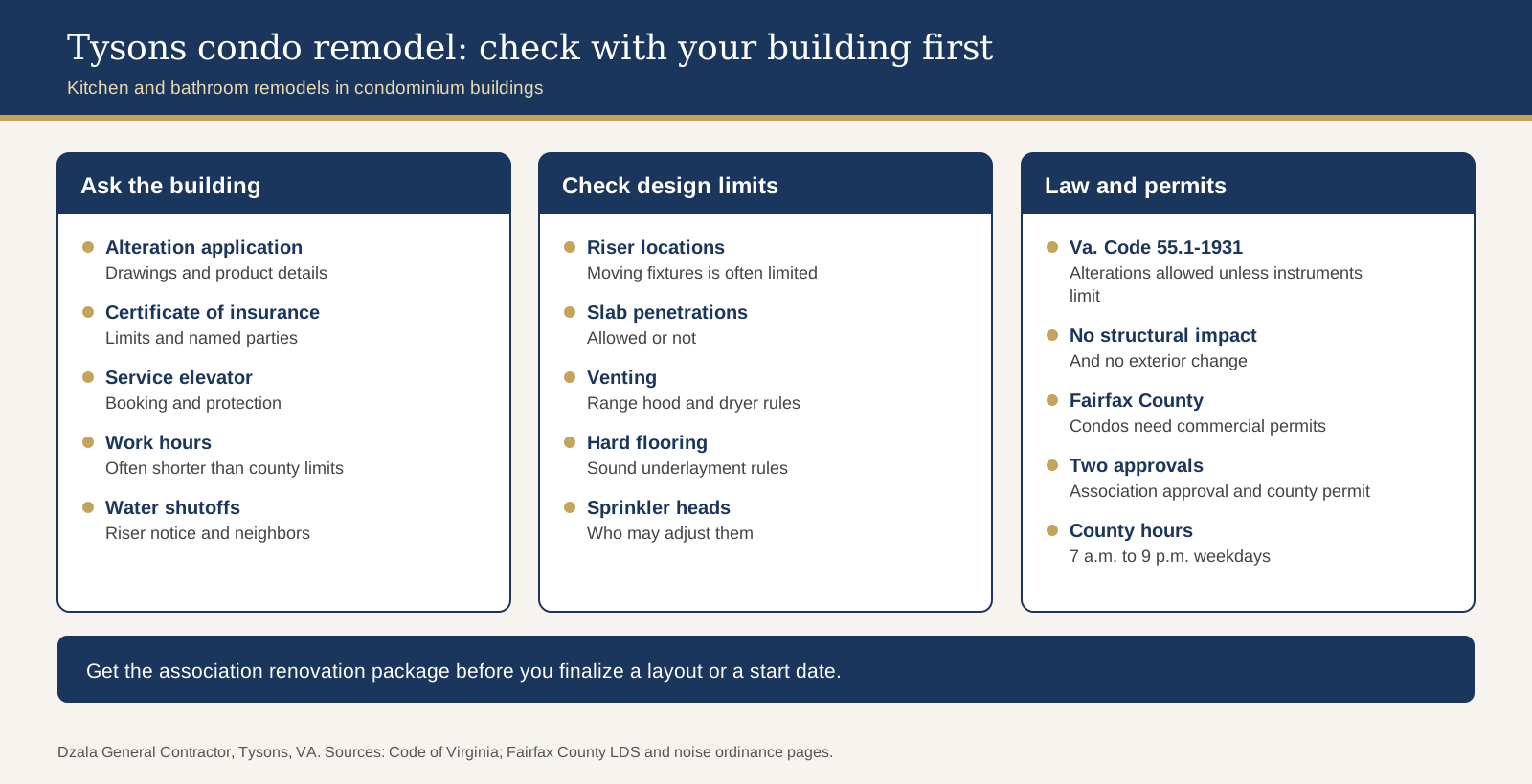
If the answers come back in writing, keep them with your contract. They shape the schedule as much as the design does.
Do Tysons condo remodels need a permit?
Often yes, and the path is different from a house. Tysons falls under Fairfax County for building permits. The county's Addition/Alteration (ALTR), Residential page explains that its residential path does not include apartment buildings and condos, because they are considered commercial under the building code and therefore require commercial building permits. The county's plumbing and electrical permit pages say the same about condos.
The county's list of work that needs a permit still applies: interior alterations, including kitchen renovations and bathroom remodels, and new or relocated plumbing, electrical and mechanical work. Replacing cabinets and countertops, replacing tile, painting and like-for-like fixture swaps in the same location are on the county's list of work that does not need a permit. Confirm the commercial record type and drawing requirements with Fairfax County Land Development Services for your scope. Association approval does not replace a county permit, and a county permit does not replace association approval.
Why do risers and plumbing locations matter so much?
In a high-rise condo, kitchens and bathrooms connect to vertical drain, vent and supply pipes called risers. Moving a sink, toilet or shower far from its riser can be difficult, because drains need slope and may have to run through the floor slab or the ceiling of the unit below. Many buildings limit or prohibit that work.
Ask early:
- Where are the risers for the kitchen and each bathroom?
- Does the building allow new penetrations in the slab?
- Who owns the pipes inside your walls under the condominium instruments?
- Will shutoff valves need to be replaced as part of the work?
Keeping fixtures near their current locations often makes approval simpler and the schedule shorter.
How do work hours and noise rules affect the schedule?
Fairfax County's noise ordinance page says construction activities are generally allowed from 7 a.m. to 9 p.m. Monday through Friday, and from 9 a.m. to 9 p.m. on weekends and holidays. Many condo buildings set shorter hours, limit weekend work, or restrict the loudest tasks, such as demolition and drilling into concrete, to certain windows.
Shorter daily hours mean more working days for the same scope. Elevator booking windows, loading dock times and water shutoff notice periods also affect the calendar. Build those limits into the schedule from the start, rather than discovering them after demolition.
How do you protect neighbors and common areas?
A condo remodel happens next to people's homes. Plan for:
- Protection for hallway floors, walls and elevator interiors along the work route
- Dust control at the unit door, with a sealed entry and daily cleanup of common areas
- Sound underlayment under new hard flooring if the rules require it
- Advance notice to neighbors for water shutoffs and loud work
- Leak prevention when plumbing is opened, since water can reach units below
What should you have ready before you sign a contract?
- The association's renovation package, rules and any alteration agreement
- Your condominium instruments, with the sections on alterations and common elements
- Riser and shutoff valve locations for the kitchen and bathrooms
- A design that respects the building's limits on plumbing moves, venting and flooring
- The contractor's certificate of insurance in the form the building requires
- Booked elevator and loading dock times for demolition and deliveries
- The commercial permit path confirmed with Fairfax County
- A schedule that reflects the building's work hours and notice periods
For what a kitchen or bathroom remodel includes, see the kitchen remodeling and bathroom remodeling service pages. For how a project moves from consultation to completion, see the process page.
Frequently asked questions about Tysons condo remodels
Do I need association approval to remodel my condo kitchen or bathroom?
Usually yes. Under Va. Code § 55.1-1931, owners may alter their units unless the condominium instruments prohibit, restrict or limit it, and most associations use those instruments and their rules to require an application and approval before work starts. Ask your property manager for the renovation package, which typically covers drawings, insurance, work hours and elevator use, and get the approval in writing before you schedule demolition.
Does a condo remodel in Tysons need a county permit?
Often yes. Tysons is under Fairfax County for permits, and the county says apartment buildings and condos are considered commercial under the building code, so they need commercial building permits instead of the residential path. Kitchen renovations, bathroom remodels and new or relocated plumbing or electrical work are on the county's permit-required list. Replacing cabinets, countertops or tile alone is on its list of work that does not need a permit.
What is a certificate of insurance for a condo remodel?
It is a document from the contractor's insurer that shows the contractor's coverage, such as general liability and workers' compensation. Many condo buildings require one before a contractor can start, and they may ask for specific limits and for the association or management company to be named on it. Ask your property manager for the exact requirements, and have the certificate sent to the building before the start date.
Can I move my kitchen or bathroom in a high-rise condo?
Sometimes, but it is often limited. Kitchens and bathrooms connect to vertical risers, and moving fixtures far from them can require new drain runs with slope through the slab or the ceiling of the unit below. Many buildings restrict that work or require the building engineer to review it. Keeping fixtures close to their current locations usually makes approval and construction simpler. Confirm the riser locations before you design.
What hours can contractors work in a Tysons condo?
The building's rules usually decide. Fairfax County generally allows construction from 7 a.m. to 9 p.m. Monday through Friday and from 9 a.m. to 9 p.m. on weekends and holidays, with a 90 dB limit at property boundaries in residential areas. Many condo associations set shorter hours, limit weekend work and restrict the loudest tasks to set windows. Ask your property manager for the hours in writing.
Who pays if a condo remodel damages a neighbor's unit?
That depends on your condominium instruments, the alteration agreement you sign with the association, and the insurance policies involved, including the contractor's coverage and your own unit owner policy. This is why buildings ask for certificates of insurance and sometimes a deposit. Read the agreement before you sign it, and ask your insurance agent how your policy applies to remodeling work.
Ready to plan your Tysons condo remodel?
See the Tysons service area page for local context. When you are ready, request a quote or call (703) 919-1645 with your building's renovation package, a floor plan or photos, and the checklist above.
Dzala General Contractor
8609 Westwood Center Dr Ste 110, Unit 119, Tysons, VA 22182, United States
Phone (703) 919-1645
Hours, Eastern time: Monday to Saturday 8 a.m. to 7 p.m., Sunday closed (ET)
Email dzalausa@gmail.com
More from the journal
Let's get started.
Tell us about your property and what you would like to change. We will review the details and follow up within one business day to arrange your free in-home consultation and written quote.
No obligation and no sales pressure. Your information stays with us.